Solar radiation, Solar parks and habitability
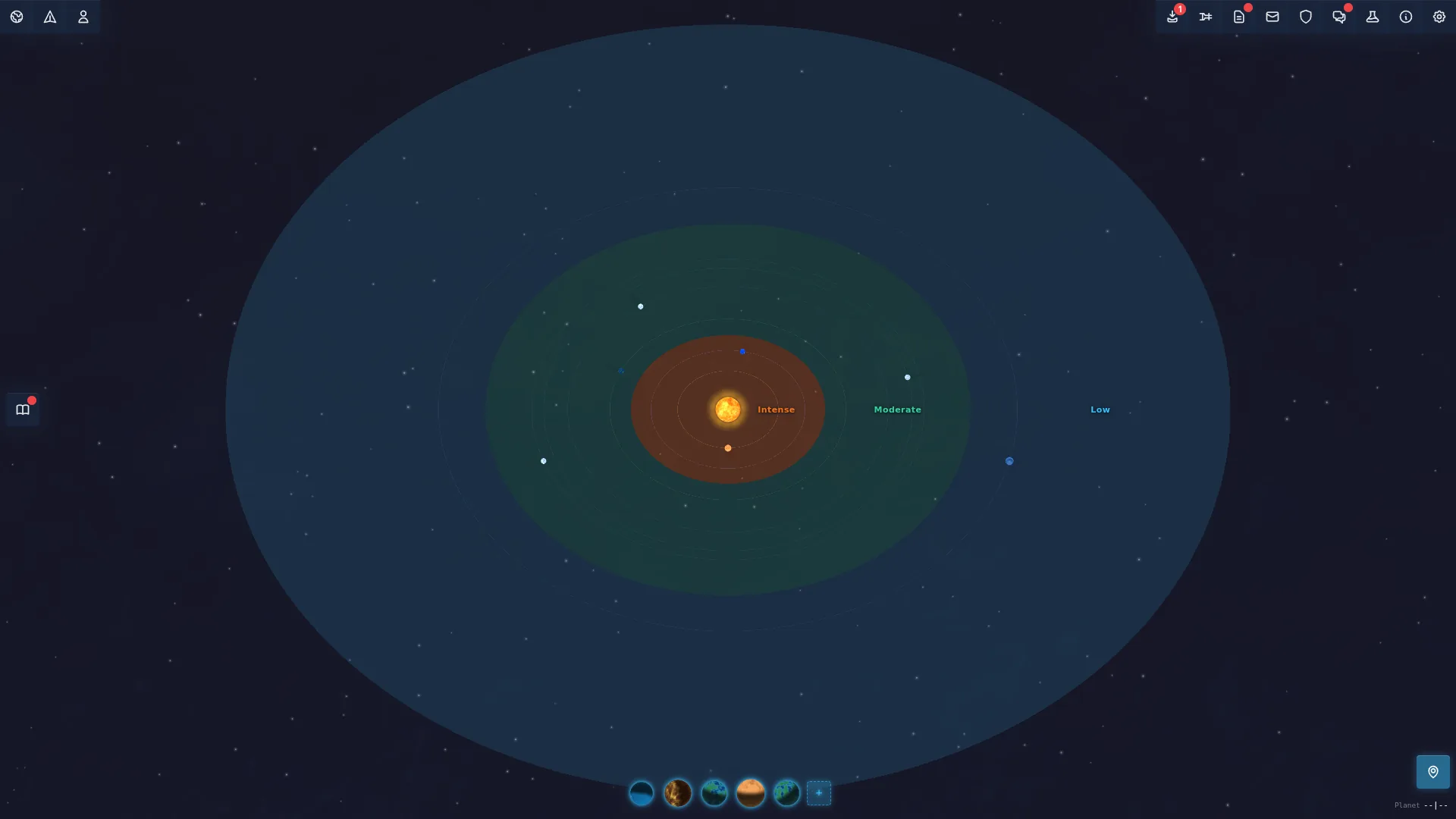
Turn on Solar radiation in Map Tools. The view shows how much light and heat each star throws.
Bands
Intense sits close to the star. Moderate wraps that inner band. Low is the outer band. The names show once the view is close enough.
A Blue giant throws Intense farther than a Red dwarf. Stars in one system add their light.
A planet that looks far from the nearer star can still sit in Intense. Both stars count.
Solar parks
A Solar park runs on the light that reaches the ground.
Each planet type has an atmosphere. Traits can thicken or thin it. Thicker air holds more light back.
After a survey the planet surface shows Surface Solar. Excellent or High means the parks can carry the colony. Low or Very low means the parks stay weak.
Habitability
Habitability is how much housing and food a planet gives you per tile. Each planet type starts with its own base habitability. If the planet is too strongly irradiated, habitability falls.
Too hot gives the strongest Solar parks and a lower share of housing and food. Great keeps the parks worth building and keeps the share. Too cold planets are still useful but may need power supplemented with a Combustion plant.
What to look for
A Solis or Courier survey shows the traits and the energy a Solar park would make. Traits can modify the atmosphere to be thicker or thinner. The band alone does not decide the colony.
A dim planet can still be the right home. A bright planet can power a colony and still be a hard place to grow.
More on light and planet types: Planets and Stars.
Clear skies, commanders.
Ion Space HQ 👋